
It's high time we now turn the popular question on its head -- when there is no growth in jobs for several years, how can the real GDP grow at 7 per cent per annum, says Mahesh Vyas.

India's economic image is not affected due to Adani Group's recent decision to pull out Rs 20,000 crore FPO (follow-on public offers) amid allegations of financial wrongdoings, Finance Minister Nirmala Sitharaman said on Saturday.

Prime Minister Narendra Modi on Saturday inaugurated the 6th India Mobile Congress at Pragati Maidan in Delhi and launched 5G services. The 5G telecom services seek to provide seamless coverage, high data rate, low latency and highly reliable communications system. The three major telecom operators of the country demonstrated one use case each in front of the prime minister to show the potential of 5G technology in India.

More people felt optimistic about their economic condition in November than in the same month a year ago, says Mahesh Vyas.

'Under-employment continues to be a very big problem.' 'What we see today is many youth who would have accepted any kind of job are not willing to accept any job.' 'They are ready to wait for a better job, one that justifies their educational qualification. 'This is one of the reasons why unemployment has risen.'

'In India, a large proportion of the labour force does not have a regular job.' 'People are mostly employed as daily wage workers, agricultural labourers, small farmers and self-employed traders.' 'These move in and out of "jobs" fairly rapidly.' 'It is the high proportion of these workers in India that makes unemployment volatile,' explains Mahesh Vyas.
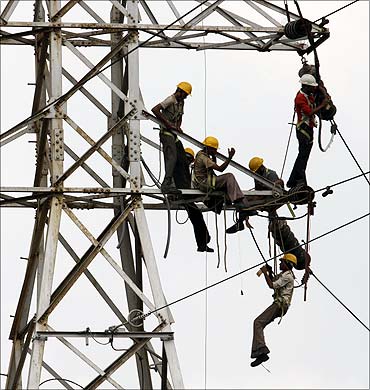
Power transmission infrastructure in 18 major cities could be potentially hacked.

'Wage earners are shrinking. In both, the organised and unorganised sectors. And, entrepreneurs are growing.' 'But the increase in entrepreneurship is of a kind that does not create salaried employment or daily wage employment,' says Mahesh Vyas.

Those who have been handed the pink slip shouldn't make too many loan queries, advises Raj Khosla.
On the back of ongoing reforms and stress on manufacturing, India. he said, can look for much bigger share in global exports.

As employers eye quality talent, employees will enjoy an upper hand in demanding high pay, better benefits, remote work options and other perks, predicts Navneet Singh, CEO, Avsar, a talent management firm.

India has entered a 'demographic sweet spot' with half of its population being under the age of 29. This 'demographic dividend' is likely to last for 2-3 decades and provides the government a unique opportunity to harness the vast potential of India's youth, points out Raj Kishore Mishra, the former civil servant turned development professional.

Gujarat, the home state of Prime Minister Narendra Modi and portrayed as 'growth engine' of India has witnessed a steep fall in new investments for the second quarter of 2014-15 compared to the first quarter of the same fiscal.

The independent institute advising the PM on jobs seems to have missed the point that the challenge is to create net additional jobs, says Mahesh Vyas.
Sivan said the Indian National Space Promotion and Authorisation Centre (In-Space) has been created under the Department of Space as a separate vertical for taking independent decisions with respect to permitting and regulating space activities of the private sector.

As India looks to mend its Covid-battered economy, one thing that will grab the attention of all concerned is the path that both wholesale and retail inflation will follow. Even the Reserve Bank of India in its latest policy statement said, "Going forward, the inflation trajectory is likely to be shaped by uncertainties impinging on the upside and the downside.

'In countries like Japan, one out of 11.7 tests turns out to be positive, which is among the highest in the world. Italy tests 6.7 persons for one positive test while the USA tests 5.3 persons and the United Kingdom 3.4'
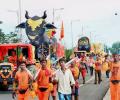
Can 3 crore out of the 8.9 crore young male population of the nine states set off on a pilgrimage that extends for about a month? If yes, then what can we infer regarding the state of the young working population in these states, asks Mahesh Vyas.
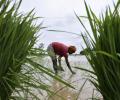
Chief economic advisor Arvind Subramanian discusses the Budget, goods and services tax, Centre-state relationship and larger issues facing the economy

If everyone had decent meaningful jobs, the rally maidans would be largely empty and, save for the Akhara babas and curious foreigners and the devout senior citizens, not very many would spare time for the Kumbh Mela, says Mahesh Vyas.

The key to job creation is to increase labour participation - draw more people into the labour force and to provide them formal jobs in the organised sectors. Self-employment is not job creation, says, Mahesh Vyas.
Given the rapid changes in the Indian labour market, there is an urgent need to have current, accurate and publicly available data through regular, dynamic and comprehensive surveys. Indeed, this was the intention behind constituting the NITI Aayog Task Force on Improving Employment Data. The attempts by the government to "improve" labour data has actually made it worse, say Rosa Abraham, Janaki Shibu & Rajendran Narayanan.

The Union Budget seems to have elicited a starkly opposite view from rural India compared to urbanites, says Mahesh Vyas.
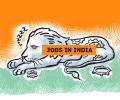
Hopefully, the small recovery in the labour force and employment seen in the September-December 2017 wave will gather momentum in the coming waves, says Mahesh Vyas.The challenge, says Mahesh Vyas, is to find the corresponding jobs for these aspirants.
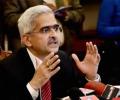
The Reserve Bank of India on Friday decided to leave benchmark interest rate unchanged at 4 per cent but maintained an accommodative stance as the economy faces heat of the second Covid wave.

The report was presented to Railway Minister D V Sadananda Gowda.
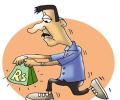
Sticky labour laws and a difficult business environment have led to employers shifting their new hiring in favour of contract labour where social security is much lesser, says Mahesh Vyas.
As of the week ended July 2017, the unemployment rate was 3.1 per cent. This is the lowest unemployment rate recorded. Rural unemployment was also very low at 2.8 per cent.

With the government claiming that the economy has been growing robustly and the Opposition refuting these claims, the common man is none the wiser, says Rajeev Sharma.
'It does not look like unemployment is a priority for the government.' 'If there was one external factor which could have made an impact on low investment and low jobs, it was the Budget and it has not made any difference.' '2020 is going to be a difficult and challenging year.'
It is necessary that at least three million additional jobs (if not more) are created every year to ensure that there isn't an increase in the stock of unemployed, says Mahesh Vyas.

'It could take 12 months or more for hiring to get back on track.' 'New opportunities would come up and there will be demand for skillsets that can help dealing with the current situation.'

Each of the larger states may need less than Rs 10,000 crore each to finance the exercise.

Nearly 31 million Indians are unemployed and looking for jobs. While economic growth has been humming along, the pace of job creation has been poor. A revealing excerpt from Dev Kar's India: Still A Shackled Giant.
The joint secretary also said a high-level task force to work on frontiers of science related to vaccines and drug testing was formed on Sunday.

The biggest worry is not the shrinking of the labour market, but the collapse of good jobs.

The Budget will obviously be crucial. But US President Donald Trump may have even more of an influence than Finance Minister Arun Jaitley when it comes to sentiment, argues Devangshu Datta.

Slowdown persists in China. India's GDP estimates for 2015-16 are liable to be pared; projections for 2016-17 are lacklustre.
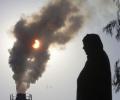
According to a study by the medical journal, the Lancet, air pollution has emerged as the deadliest form of pollution and the fourth leading risk factor for premature deaths worldwide.

The lockdown should have been used to drum into Indians' head the reasons for social distancing and the necessity for it, and the costs of not applying it in our daily lives and it should have been used to set up the systems that would manage large numbers of infected, observes Mihir S Sharma.
